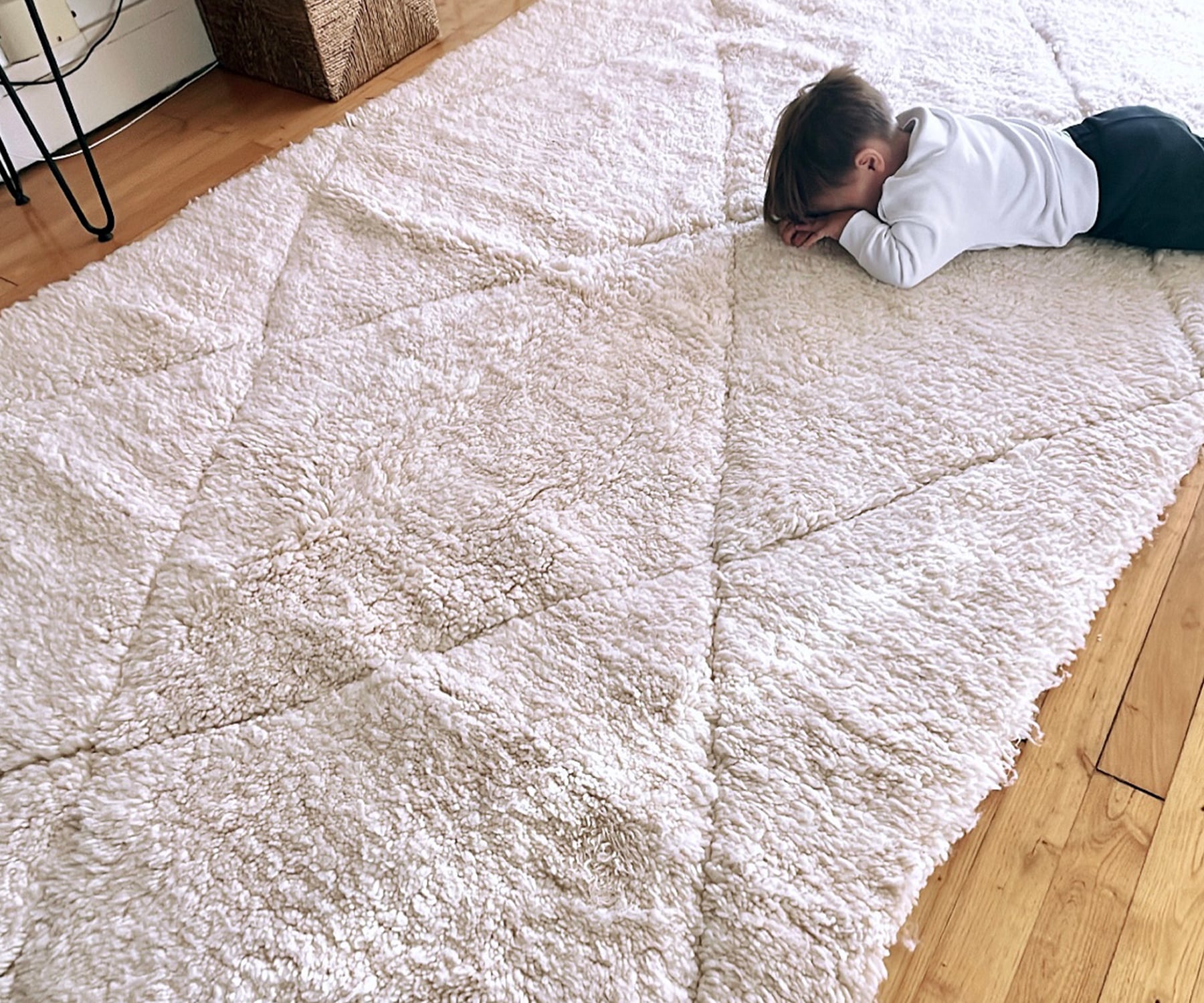
To recognise a real Berber wool rug, turn it over: on a hand-knotted rug, you can see the knots and the pattern on the back, with small irregularities. Also check that the fringes are the ends of the warp threads (not sewn on), that the material really is wool, and be wary of prices that are too low. Here is our complete guide to buying an authentic Berber rug with confidence.
What is a real Berber rug?
A Berber rug is a rug hand-woven by the women of Morocco's Amazigh tribes, mainly in the Middle and High Atlas. It is made of sheep's wool on a traditional loom, with patterns handed down from generation to generation. The best known are the Beni Ourain, the Mrirt, the Azilal, the Zanafi and the Hanbel (discover them in our guide to the different types of Moroccan Berber rugs).
The success of this style has led to many factory copies: "Berber-style" rugs made in factories, often from polypropylene or polyester. They copy the patterns, but not the quality.
7 ways to recognise an authentic Berber wool rug
1. The back of the rug

This is the most reliable test. On a hand-knotted rug, the back shows the knots one by one and mirrors the design on the front. The rows are slightly irregular. On a factory rug, the back is perfectly even, often covered with a canvas, latex or glued backing.
2. The fringes

On a handmade rug, the fringes are the ends of the warp threads the knots were tied on: they are part of the rug's structure. If they are sewn or glued under the edge, the rug was made mechanically.
3. The material: real wool
Sheep's wool is supple, slightly greasy to the touch and warm, and it springs back when pressed. A synthetic fibre is shinier, more "plastic" and flattens. A simple test is to burn a strand of fringe: wool smells like burnt hair and leaves a crumbly ash, while synthetic fibre melts into a hard bead.
4. The irregularities
Slightly asymmetric patterns, one diamond a little bigger than the next, a shade of wool that varies: these small imperfections are not defects. They prove the rug was hand-woven, from memory, by a weaver.
5. Weight and thickness
A real Beni Ourain rug is heavy: its thick, dense wool weighs several kilos in a large size. A rug that is very light for its size should make you suspicious.
6. Berber patterns

Berber patterns are geometric: diamonds, chevrons, zigzag lines, crosses. Each region has its own vocabulary: black diamonds on white for the Beni Ourain, free-form colourful patterns for the Azilal, friezes and stripes for the Hanbel. These symbols are linked to protection, fertility or family life.
7. The price
A large hand-knotted rug represents several weeks of work for a weaver. A "Berber rug" measuring 200 × 300 cm sold for less than a hundred euros cannot be handmade. The price of a real rug reflects the amount of wool, the knot density and the weaving time.
Berber rug materials and how it is made

The wool is sheared, washed, carded and spun before being dyed (or left natural). The weaver then sets up the warp threads on an upright loom and knots the wool row after row. To learn more, read how a colourful Berber rug is made.
Authentic rug or copy: why it matters
Buying a factory rug means paying less for an object that won't last. Buying a handmade rug means investing in a piece that will stay with you for years, and supporting the women who weave it.
At Safia Rugs, we work directly with weavers from the Middle Atlas who are paid fairly for their work: this is the fight of our founder, Safae. To feel the wool before you buy, order a rug sample. And if you have a specific project in mind, we will make your custom Berber rug.
Frequently asked questions
How can you tell if a Berber rug is handmade?
Look at the back: the knots should be visible and the design readable, with slight irregularities. The fringes should continue from the warp threads and not be sewn on.
Does a Berber wool rug shed?
Yes, a little, in the first few weeks: this is normal for natural wool. A few passes with a vacuum cleaner without a rotating brush are enough, and then it stops.
Where can I buy a real Berber rug?
From an artisan or a brand that works directly with the weavers and can tell you who wove your rug, where and how long it took.