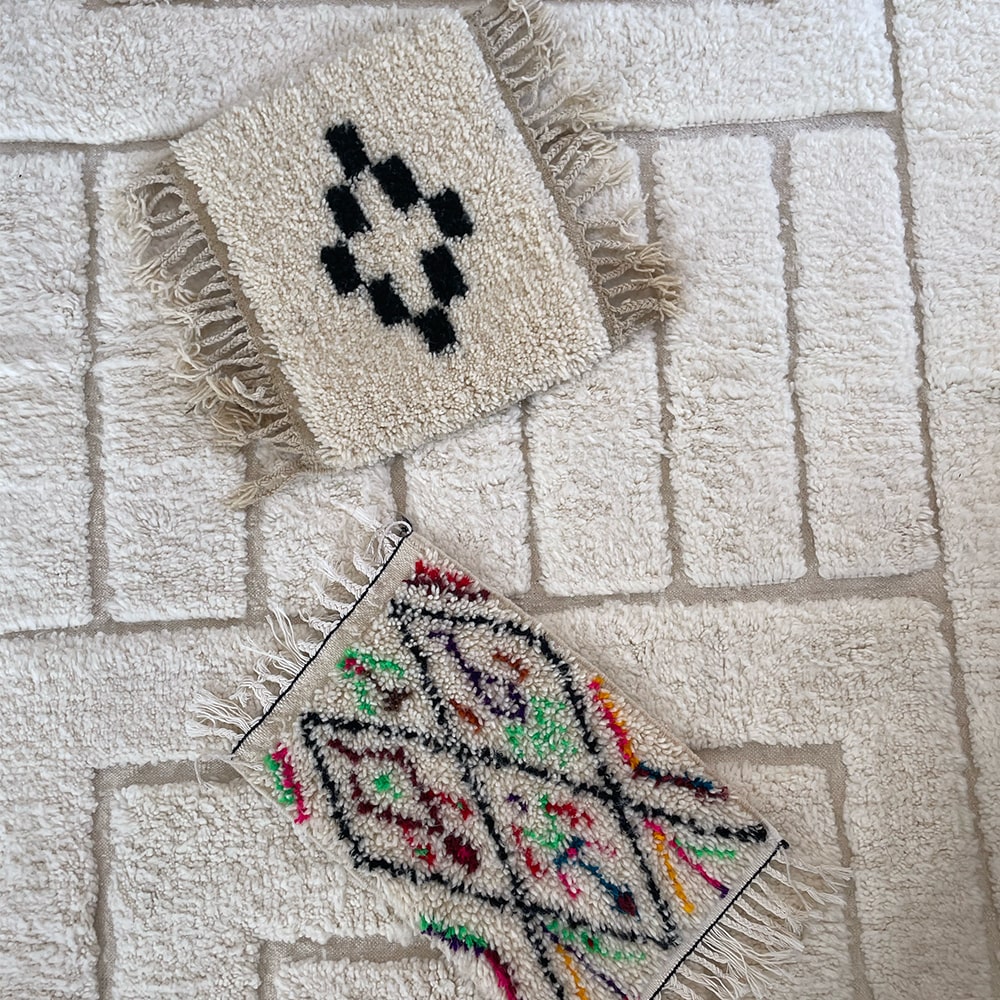
A colourful Berber rug is the easiest way to give a room character. Hand-woven in Morocco, it brings warmth, colour and a real story to your home, without ever looking like a catalogue interior. Here is why it is so popular, how it is made and how to choose the right one.
Why choose a colourful Berber rug?
A colourful Moroccan rug structures a room in one move: it defines the seating area, warms up a cold floor (tiles, polished concrete) and creates a focal point for the rest of the decor.
- A one-of-a-kind piece: every rug is hand-knotted, so its patterns and shades are never exactly repeated.
- Natural, durable wool: sheep's wool from the Atlas is hard-wearing, insulating and ages well.
- An easy style to match: it brightens a white or Scandinavian interior and pairs naturally with wood, rattan and earthy tones.
- Simple care: vacuuming without a rotating brush is enough day to day (see our tips on how to clean a wool rug).
Which Berber rugs are colourful?

Several families of Moroccan Berber rugs play with colour:
- The Azilal rug: an ecru background with free-form patterns in bright colours. It is the most artistic.
- The colourful Beni Ourain: the softness of a Beni Ourain with patterns in pink, orange, blue or terracotta, or even a fully dyed background (mustard, blue…).
- The Hanbel rug: a flat-woven kilim, often red, decorated with friezes and stripes.
- The Zanafi rug: blocks and bands of colour (sea green, terracotta, mustard) for a graphic style.
- The Boucherouite: woven from strips of recycled fabric, it is the most multicoloured of all.
How is a colourful Berber rug made?
1. Shearing and washing the wool

It all starts with the wool of sheep raised in the mountains of the Middle Atlas. After shearing, the wool is washed several times to remove grease and impurities, then dried in the open air.
2. Carding and spinning
The wool is then carded to untangle and align the fibres, and spun. Even spinning gives a strong yarn, which makes a hard-wearing rug that is pleasant to the touch.
3. Dyeing

This is the step that brings a colourful rug to life. The wool is dipped in dye baths before weaving. Traditionally, the colours came from plants and minerals (madder for red, henna, indigo…). At Safia Rugs, you can choose your shades from the 208 colours of our wool chart.
4. Hand-knotting

On an upright loom, the weaver knots thousands of strands of wool one by one around the warp threads, row after row. The patterns are often woven from memory. A large rug takes several weeks to make. At Safia Rugs, these women are paid fairly for their work: that is our fight.
How to style a colourful Berber rug
- White or Scandinavian interior: go for an Azilal or a Beni Ourain with bold patterns; it will become the centrepiece.
- Boho interior: pick up the rug's colours in cushions, rattan and plants.
- Contemporary interior: choose a Zanafi or a dyed-background Beni Ourain, with strong colours but graphic patterns.
- Small spaces: a small colourful Hanbel in an entrance or bedroom is enough to change the mood.
For inspiration, see our colourful rugs in our customers' homes.
Authentic colourful Berber rug or factory copy?
The success of the Berber rug has led to many factory-made copies in synthetic fibres. They are cheaper but wear out quickly and have neither the softness nor the warmth of wool. To tell the difference, follow our guide to spotting a real Berber wool rug.
Want your colourful rug in the exact colours of your home? Create your custom Berber rug: we weave it to your size, in your colours.
Frequently asked questions
Does a colourful Berber rug bleed?
A properly dyed rug does not bleed with normal use. Simply avoid long exposure to direct sunlight and soaking it in water, which can fade the colours or make them run.
Which colourful Berber rug for a living room?
For a living room, a large Azilal or colourful Beni Ourain (for example 200 × 300 cm) lets you place the front legs of the sofa on it and ties the space together.